
T: +86-15800900153
E: songwenyan@windouble.com.cn
E: songwenyan@windouble.com.cn
No.1230, Beiwu Road, Minhang District,Shanghai,China
Views: 0 Author: Site Editor Publish Time: 2026-07-12 Origin: Site


In the world of motion control systems, feedback devices like encoders and resolvers play a crucial role in determining shaft position, speed, and angle. Both of these technologies have proven useful in a wide range of applications. However, when it comes to operating in challenging industrial environments—where extreme conditions such as high temperatures, vibration, and dust are common—encoders may not always provide the reliability needed. This is where the Dual Speed Resolver comes in. Designed to withstand harsh conditions and provide superior precision, it offers an ideal solution for critical systems requiring stable and accurate position feedback. In this article, we will explore the differences between encoders and resolvers, examine why dual-speed resolvers are more robust in tough environments, and discuss when and why you should choose this technology.
An encoder is an electromechanical device that converts rotational position or motion into a digital signal. The most common types of encoders are optical and magnetic, which generate pulses that correspond to the rotation of a shaft. Optical encoders use light to detect position changes, while magnetic encoders rely on magnetic fields. These pulses are then processed to provide the precise position feedback that control systems rely on.
A resolver, on the other hand, is an analog position sensor that works similarly to a transformer. It consists of a stator and rotor, with alternating current (AC) excitation provided to the stator. This generates a sine/cosine signal from the rotor's position, which is then used to calculate the shaft's angle. Unlike encoders, resolvers do not rely on digital pulses and offer an inherently more robust solution, especially in challenging environments.
The primary difference between resolvers and encoders lies in the signal they produce. Encoders provide a digital output, while resolvers generate an analog signal that is later converted into digital data via a resolver-to-digital converter (RDC). This makes resolvers less prone to certain types of interference and more suitable for long-term reliability.
While encoders are widely used, they are not always the best option for extreme conditions. Let's take a closer look at why encoders might fail when exposed to harsh environments.
Optical encoders, in particular, can be sensitive to environmental contaminants. Dust, moisture, and pollutants can interfere with the light signals used for position detection, leading to inaccurate readings or even total failure of the device. In industries like mining, construction, and food processing, where dust and moisture are prevalent, this becomes a significant drawback.
Magnetic and optical encoders can also suffer from performance degradation under extreme temperature conditions. High temperatures may cause the encoder components to overheat or distort, leading to inaccuracies. Vibration can cause mechanical components to loosen or wear out, while electromagnetic interference (EMI) can disrupt the signal processing, rendering the encoder unreliable.
Encoders often require additional protective measures—such as sealed housings or complex filtering circuits—to handle these harsh environments, which adds to the overall system complexity and cost.
In challenging environments, encoders tend to have a shorter lifespan compared to resolvers. Over time, exposure to harsh conditions can cause wear and tear on the optical or magnetic components. This means encoders require more frequent maintenance, repair, or replacement, which leads to increased downtime and higher operational costs.
In contrast to encoders, dual-speed resolvers are designed with robustness and reliability in mind. Let's explore why this technology is better suited for industrial applications where conditions are far from ideal.
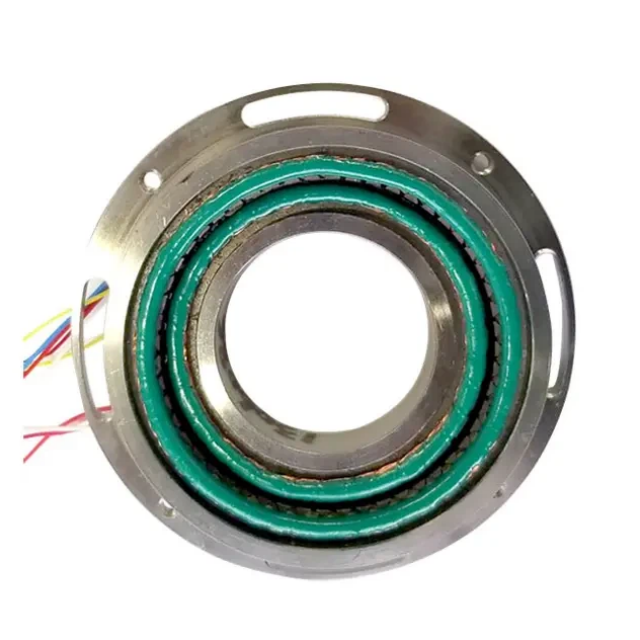
A dual-speed resolver is essentially a combination of two resolvers—a coarse resolver and a fine resolver—integrated into a single unit. This design is inherently more durable because it contains fewer delicate electronic components. The resolver operates based on an analog transformer principle, with the stator and rotor generating a signal that reflects the shaft's position. Since there are no optical or magnetic components, resolvers are far less prone to damage from environmental contaminants like dust, moisture, or electromagnetic interference.
The dual-speed resolver combines both coarse and fine resolvers into one device, allowing it to track both large-angle rotations and precise position changes. This integration ensures high accuracy and excellent reliability, even in challenging environments. Because of this robust design, dual-speed resolvers continue to perform effectively in industrial applications that demand high precision, such as heavy machinery, robotics, and automation systems.
The dual-speed resolver is designed to be long-lasting, with a minimal need for maintenance. Unlike encoders, which may require frequent calibration or cleaning, resolvers are built to withstand high temperatures, vibration, and shock without significant degradation in performance. This results in reduced downtime and lower overall maintenance costs, making them ideal for industries where reliability and uptime are paramount.
The advantages of the dual-speed resolver become particularly apparent in real-world applications, especially in environments where performance is critical, and conditions are far from ideal.
In industries like manufacturing, mining, and construction, heavy industrial equipment such as forging machines, excavators, and large robots are subjected to extreme conditions. These machines are often exposed to high temperatures, vibration, dust, and mechanical shock. Dual-speed resolvers provide precise, reliable position feedback even in these harsh conditions, where encoders would typically fail. This ensures smooth and accurate operation, even in the most demanding environments.
For applications such as outdoor antenna positioning or navigation platforms, dual-speed resolvers are the perfect choice. These systems often operate in remote locations where exposure to dust, rain, and extreme temperatures is common. With the rugged design of the dual-speed resolver, these systems can continue to function reliably without the need for frequent maintenance or recalibration, ensuring long-term stability.
In the aerospace and defense sectors, systems must be capable of operating in highly controlled and extreme conditions. Dual-speed resolvers are well-suited for these applications, as they can withstand radiation, electromagnetic interference, and other environmental factors that could disrupt digital encoders. Additionally, the ability of resolvers to provide continuous position feedback with high accuracy makes them invaluable in mission-critical systems.
While dual-speed resolvers offer numerous advantages, there are situations where encoders may still be the preferred choice. Let's discuss the scenarios where an encoder might be more suitable and when you should consider switching to a resolver.
Encoders work best in environments that are clean, dry, and relatively stable. In applications where digital output is essential, and the system is not exposed to extreme conditions, encoders are a great option. They are also a better fit for systems that require compact integration and ease of installation.
However, if your system operates in environments subject to high temperatures, vibration, dust, or electromagnetic interference, then the dual-speed resolver is the better choice. It offers superior performance in harsh environments and provides long-term reliability with minimal maintenance. For applications requiring precision and durability, such as heavy machinery, robotics, and military-grade systems, a dual-speed resolver should be the preferred solution.
At Shanghai Yingshuang (Windouble) Electric Machinery Technology Co., Ltd., we specialize in the development and manufacturing of high-quality dual-speed resolvers that are designed to withstand the toughest industrial conditions. Our products are built with robust construction, ensuring they remain reliable even under extreme temperature fluctuations, high vibration, and exposure to pollutants.
If your operations involve heavy machinery, robotics, outdoor equipment, or any system that operates in harsh conditions, our dual-speed resolver is the ideal solution. Contact us today to discuss how our products can meet your specific requirements and help improve your system's performance.
In industries where reliable and accurate position feedback is essential, dual-speed resolvers offer unparalleled performance compared to encoders, especially in tough industrial environments. Their rugged design, ability to function in extreme conditions, and long-term reliability make them the go-to solution for many high-precision applications. When compared to encoders, dual-speed resolvers are more robust, durable, and suitable for environments where failure is not an option. If your operations require high-precision angle detection in demanding conditions, consider switching to a dual-speed resolver for improved performance and reliability. Contact us to learn more about how our products can optimize your systems.
Q1: What is the primary advantage of a dual-speed resolver over an encoder?
A1: The dual-speed resolver offers greater reliability and precision in harsh environments, with minimal maintenance required. Unlike encoders, which are sensitive to dust, moisture, and temperature, resolvers perform well in extreme conditions.
Q2: Can dual-speed resolvers handle high-vibration environments?
A2: Yes, dual-speed resolvers are designed to withstand high levels of vibration and mechanical shock, making them ideal for use in industries such as manufacturing and heavy equipment.
Q3: When is it better to use an encoder instead of a resolver?
A3: Encoders are suitable for environments where cleanliness and stability are important, and when digital outputs are needed for system compatibility.
Q4: How do dual-speed resolvers maintain accuracy in extreme environments?
A4: Dual-speed resolvers maintain accuracy by using analog signals, which are less affected by interference compared to digital systems like encoders. Their simple design makes them more durable and reliable in harsh conditions.