
T: +86-15800900153
E: songwenyan@windouble.com.cn
E: songwenyan@windouble.com.cn
No.1230, Beiwu Road, Minhang District,Shanghai,China
Views: 0 Author: Site Editor Publish Time: 2026-07-16 Origin: Site


In modern industrial applications, the need for precise angle detection is more critical than ever. From servo motors to robotics, high-precision systems are integral to performance, reliability, and efficiency. However, many traditional sensors struggle to meet the exacting standards required for ultra-precise angle detection—particularly when it comes to achieving the level of accuracy from arcminute to arcsecond. That's where the Dual Speed Resolver comes in. Engineered to provide incredibly accurate and reliable position feedback, this technology is transforming how systems measure rotational angles. In this article, we'll explore the dual-speed resolver, its design, advantages over other technologies, and why it's the solution for applications requiring ultra-high precision.
A dual-speed resolver is an advanced position sensor designed to provide high-precision angle measurement. It combines the functions of two resolvers into one unit: a coarse resolver and a fine resolver, each dedicated to tracking different aspects of a system's rotational movement.
The dual-speed resolver consists of a single-pole resolver (known as the coarse resolver) and a multipole resolver (the fine resolver), both housed in the same stator and rotor core. The coarse resolver monitors the overall number of revolutions, while the fine resolver tracks the position of the shaft within each revolution. This dual setup allows the resolver to achieve both coarse resolution (for larger angle increments) and fine resolution (for smaller, more precise angle measurements).
The coarse resolver is responsible for counting the number of revolutions made by the shaft, while the fine resolver measures the shaft's exact position during each individual revolution. By working in tandem, these two resolvers provide a complete picture of the shaft's absolute position—without the need for additional sensors or mechanical encoders.
The beauty of the dual-speed resolver lies in how it combines the signals from the coarse and fine resolvers. This fusion allows for the determination of the absolute mechanical angle over a 360° rotation with extraordinary precision. The dual-speed resolver generates analog sine and cosine signals that can be decoded into precise position data, offering high-accuracy feedback for motion control systems.
Compared to traditional single-speed resolvers, the dual-speed resolver offers distinct advantages in precision and performance.
Single-speed resolvers typically offer good resolution but are limited when it comes to providing the ultra-high precision necessary for demanding applications. They may track the overall number of revolutions accurately but struggle to achieve the fine angular accuracy required for many modern systems.
In contrast, the dual-speed resolver incorporates both coarse and fine measurement systems, allowing it to track larger angle increments (coarse) while simultaneously offering the fine angular resolution required for high-precision applications. This dual-track approach significantly improves the accuracy of rotational feedback, reducing cumulative errors and improving the overall system's repeatability and precision.
The key advantage of the dual-speed resolver is its ability to measure both large and small angular increments simultaneously. The coarse resolver covers the broader rotational range, while the fine resolver handles smaller, more precise angular changes. This method prevents any errors from accumulating over multiple rotations, ensuring that each angle measurement remains accurate and repeatable across the entire range of motion.
The dual-speed resolver is a versatile technology used in many industries where high-precision angle feedback is required.
One of the most common uses of the dual-speed resolver is in industrial servo motors, where precise angular feedback is crucial for accurate motion control. Robotic joints also benefit from this technology, enabling fine movements in automation systems. Additionally, CNC machines, antennas, and other high-precision equipment rely on resolvers to track shaft position with extreme accuracy.
What sets resolvers apart from other position sensors, like optical encoders or magnetic encoders, is their ability to maintain accuracy even in harsh conditions. The dual-speed resolver excels in extreme environments, where factors such as high temperature, vibration, or dust can negatively affect other types of sensors. Unlike optical encoders, which can be sensitive to dust or moisture, resolvers offer a more reliable, stable solution in challenging environments.
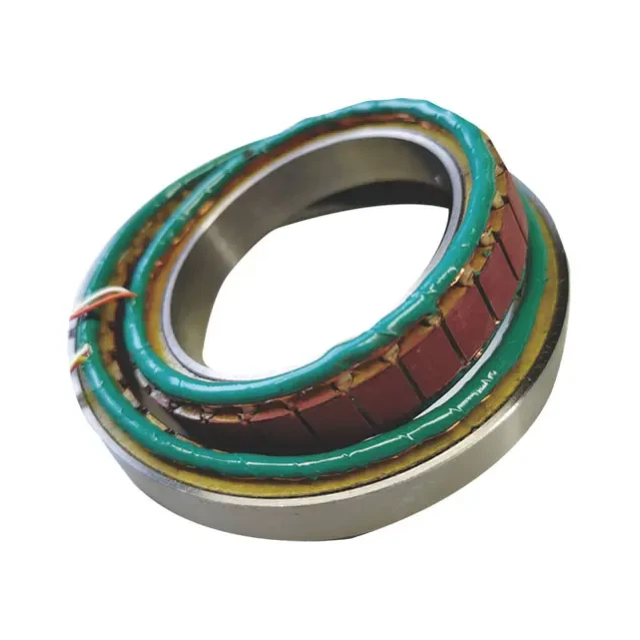
In many industrial applications, the requirement for high-precision shaft angle detection goes beyond what traditional sensors can provide. The dual-speed resolver fills this gap by offering the ability to measure shaft position from arcminute accuracy to arcsecond precision.
The dual-speed resolver is designed to achieve high-precision measurements that surpass the capabilities of standard resolvers. By combining the outputs of the coarse and fine resolvers, this system reduces the error margins that can accumulate in traditional single-speed resolvers. As a result, the dual-speed resolver delivers highly accurate mechanical angle feedback, improving overall system performance.
Several factors contribute to the precision of the dual-speed resolver, including manufacturing tolerances, the design of the resolver windings, and the decoding process of the resolver signal. Advances in resolver-to-digital conversion (RDC) technology have further enhanced the accuracy of this measurement, helping to achieve arcsecond-level precision in real-world applications.
When precision, reliability, and performance are crucial, our dual-speed resolver is the ideal solution for high-demand applications.
Our dual-speed resolver features both single-pole and multipole windings integrated into the same stator and rotor core. This design improves the stability and consistency of the resolver, ensuring that the system can maintain high accuracy even under challenging conditions.
Our dual-speed resolver is built to offer superior performance, whether in high-precision manufacturing processes, robotics, or demanding industrial systems. It excels in environments subject to extreme temperatures, vibrations, or electromagnetic interference, offering long-term reliability and minimal maintenance needs.
For more information about how our dual-speed resolver can enhance your system's performance, feel free to contact us. We would be happy to discuss your specific needs and help you choose the right solution for your application.
The dual-speed resolver is a cutting-edge technology that addresses the growing need for ultra-high precision in shaft angle detection. Whether used in industrial servo motors, robotics, or CNC machinery, this advanced position sensor provides unrivaled accuracy and reliability. With its ability to measure angles from arcminute to arcsecond precision, the dual-speed resolver is revolutionizing the way motion control systems operate. For those seeking optimal performance and reliability in demanding environments, our dual-speed resolver offers a perfect solution. Contact us to learn more about how we can help improve your system's precision and efficiency.
Q1: What is the key advantage of using a dual-speed resolver over a traditional single-speed resolver?
A1: The key advantage of a dual-speed resolver is its ability to measure both large angular increments (coarse) and fine angular details (fine) simultaneously, providing significantly higher precision and repeatability than single-speed resolvers.
Q2: Can dual-speed resolvers be used in extreme conditions?
A2: Yes, dual-speed resolvers are highly durable and perform well in harsh environments, including high temperatures, vibrations, and electromagnetic interference. They are more reliable than optical or magnetic encoders in such conditions.
Q3: What industries typically use dual-speed resolvers?
A3: Dual-speed resolvers are used in industries such as robotics, CNC machinery, industrial servo motors, aerospace, and defense, where high-precision shaft angle feedback is crucial.
Q4: How do dual-speed resolvers achieve arcsecond-level precision?
A4: Dual-speed resolvers combine the signals from coarse and fine resolvers, allowing for ultra-precise position feedback. This, along with advancements in resolver-to-digital conversion technology, enables arcsecond-level accuracy.